

Power banks remain attractive corporate gifts because they are useful, portable and easy to personalise. They are also electrical products containing batteries, which means a sourcing decision based only on capacity, casing and logo area can expose buyers and suppliers to avoidable safety, regulatory and end-of-life risks.
For India’s promotional-products industry, the practical standard is simple: treat a branded power bank as regulated electronics first and merchandise second. That requires proof of product conformity, traceable models, accurate capacity claims, controlled branding and a credible battery-waste pathway.
Key takeaways
- Match the supplied model to its applicable BIS registration and test evidence.
- Verify the battery, finished product, rated capacity and labelling as separate checkpoints.
- Do not let custom branding cover mandatory product information or traceability marks.
- Clarify which entity is the “producer” for battery-waste EPR obligations.
- Keep samples, purchase records and inspection evidence for every campaign batch.
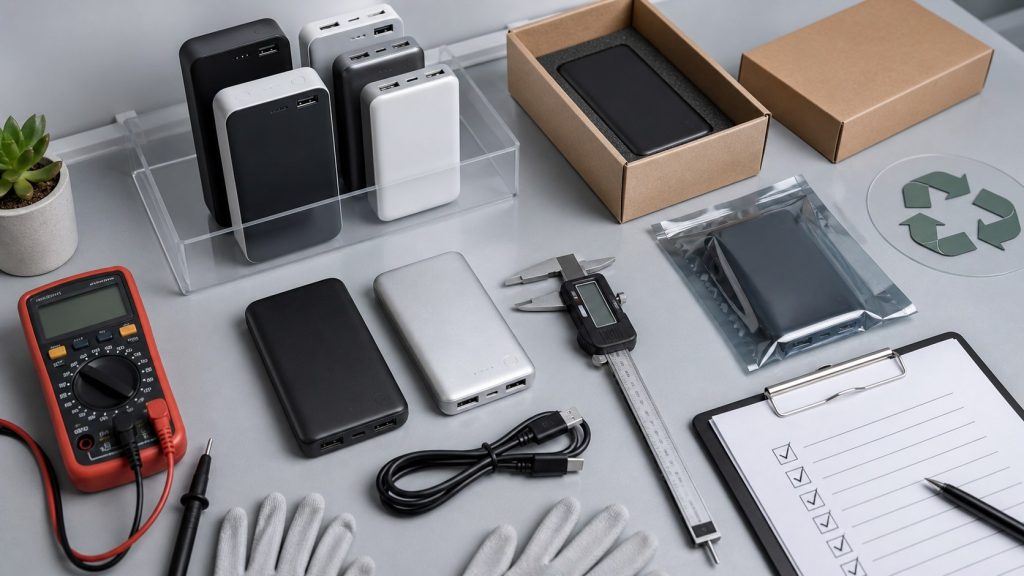
Why power-bank gifting carries more risk than standard merchandise
A bottle or notebook can fail a buyer’s quality expectations. A poorly specified power bank can also create charging, overheating, transport and disposal concerns. The risk increases when a generic device changes hands through an importer, promotional distributor, decorator and corporate buyer before reaching the recipient.
India’s Bureau of Indian Standards lists power banks for portable applications under its published test-report resources for IS 13252 (Part 1). The BIS registration framework applies to notified electronics products, and suppliers should verify the current compulsory-registration requirement, the registered model and the manufacturer details before committing a campaign.
This is not satisfied by receiving a registration number in a quotation. A buyer should confirm that the number is genuine, current, applicable to the offered model and connected to the actual manufacturing source. If model codes, ratings or factory details do not align, the discrepancy needs resolution before production.
Confirm the finished product, battery and claims
Start with the exact unit—not a visually similar sample. Record its model number, input and output ratings, connector types, cell chemistry, nominal capacity, rated output capacity, dimensions, weight and safety features. Capacity claims must be clearly defined because the internal cell rating and usable output at a different voltage are not the same measurement.
Check for safeguards appropriate to the design, such as protection against overcharge, over-discharge, short circuit and excessive current. Ask who assembled the battery pack and who owns the finished-product registration. For imported products, document the importer and authorised source rather than relying on an anonymous trading description.
Customisation can introduce a second layer of risk. Printing, engraving or applying a sleeve should not obstruct ventilation, controls, indicators or mandatory information. Packaging must preserve model traceability and provide clear, accurate use and disposal guidance. Never replace regulated labelling with campaign artwork.
Build a campaign-level evidence pack
A dependable supplier should be able to assemble one controlled file that connects the approved sample to the delivered batch. The file should be reviewed by sourcing or quality personnel, not left entirely with the sales team.
- BIS registration details and the exact covered model
- Manufacturer, importer and seller identity
- Applicable test report or conformity evidence
- Technical specification sheet with electrical ratings
- Battery and cell information supplied by the manufacturer
- Approved artwork showing mandatory marks remain visible
- Packaging, user instructions and disposal information
- Purchase order, batch or serial traceability and inspection record
- Warranty, complaint escalation and recall contact
- Transport and storage instructions for lithium-battery products
Use the BIS Know Your Standard service to locate current standard information, amendments, notifications, licences and laboratories. Requirements can change, so a previous campaign file should be treated as reference material—not automatic approval for a new model or new batch.
Plan battery-waste responsibility before the gift is distributed
Under India’s Battery Waste Management Rules, producers have Extended Producer Responsibility for batteries they introduce to the market. The Central Pollution Control Board’s producer-registration guidance describes registration through the central portal and recycling obligations supported by EPR certificates.
The crucial commercial question is: who is the producer in the actual supply chain? Depending on the arrangement, responsibilities may sit with a manufacturer, assembler, importer or an entity placing batteries on the market under its own brand. A promotional distributor should not casually claim EPR compliance on behalf of another company.
Before sale, identify the responsible registered entity and obtain evidence appropriate to the transaction. Put take-back, recycling and reporting responsibilities in writing. For corporate campaigns, include recipient-facing disposal guidance and a route to an authorised collection or recycling system.
A March 2026 parliamentary response confirmed that India operates online EPR portals for battery waste and e-waste. It also distinguishes these waste streams. Suppliers should therefore classify the product correctly instead of assuming one generic “recycling certificate” covers every obligation.
Use a pre-dispatch control plan, not a last-minute sample check
Approve a sealed reference sample before mass branding. Then inspect production units against that sample and the technical file. Sampling should cover identity and appearance as well as charging, output, indicators, ports, labelling, packaging and obvious damage.
Set written rejection rules for swelling, unusual heat, inconsistent ratings, loose ports, damaged casings, missing labels or packaging deviations. Quarantine failed units and document disposition. Store and transport products within the manufacturer’s stated conditions, and avoid leaving packed batteries in excessive heat.
A practical buyer checklist
- Freeze the exact model before pricing and artwork approval.
- Verify BIS details against an official source.
- Reconcile manufacturer, importer and seller identities.
- Confirm technical ratings and capacity terminology.
- Review safety features and warranty coverage.
- Protect mandatory marks during decoration.
- Identify the entity responsible for battery EPR.
- Approve packaging, instructions and disposal guidance.
- Inspect the delivered batch against a sealed sample.
- Maintain complaint, traceability and recall records.
Responsible technology gifting starts before artwork
The best power-bank gift is not simply the one with the highest stated capacity or most premium finish. It is the one whose identity, conformity, performance, branding and end-of-life route can be explained with evidence.
GPPPN members can use this framework to strengthen supplier onboarding and buyer briefs for electronic merchandise. The objective is not to discourage technology gifts, but to make them safer, more transparent and more professionally sourced across India’s promotional-products community.

